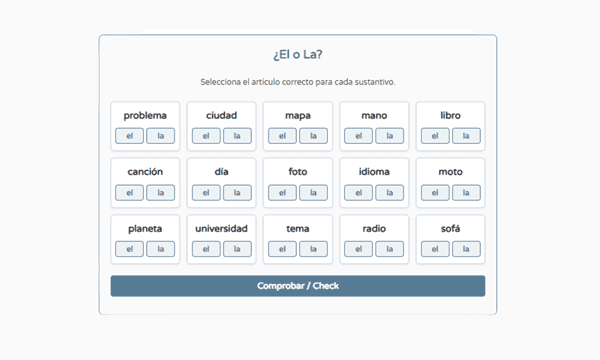
Learning the gender of nouns in Spanish can be quite a challenge. Although the basic rule tells us that words ending in “o” are masculine (el) and those ending in “a” are feminine (la), the language is full of important exceptions.
In this interactive online exercise, you’ll test your memory and knowledge with the most common “tricky words” in the vocabulary. Select the correct article in Spanish for each word. Don’t be fooled by appearances!
¿El o La?
Selecciona el artículo correcto para cada sustantivo.
problema
ciudad
mapa
mano
libro
canción
día
foto
idioma
moto
planeta
universidad
tema
radio
sofá
Tips for Mastering Spanish Gender
To make sure you never fall into these traps, memorize these three quick tips on exceptions in Spanish vocabulary:
- Greek origins (-ma, -ta, -pa). Many words that end in “a” but are masculine come from Greek. That’s why we say el problema or el planeta.
- Abbreviated words. Words like la foto or la radio end in “o,” but use the feminine article “la” because they’re actually short forms of longer feminine words (fotografía, radiodifusión).
- The endings -ción and -dad. Any noun ending in these letters is always feminine, without exception. For example: la canción, la ciudad.