Verb “Ser” in Spanish: Present Tense Fill-in-the-Blanks Exercise

If you are a beginner learning Spanish, mastering the verb ser (to be) in the present indicative tense is an absolute must. This is one of the most frequently used verbs in the language, used for introducing yourself, talking about your profession, describing your friends...

With this interactive fill-in-the-blanks exercise below, you can practice conjugating this vital irregular verb in an easy way. ¡Vamos allá!

Ejercicio: El verbo SER en presente

Completa las frases escribiendo la forma correcta del verbo ser en presente de indicativo.

1. Yo estudiante de español.
2. ¿De dónde tú?
3. María profesora de matemáticas.
4. Nosotros amigos desde la infancia.
5. ¿Vosotros de Argentina o de España?
6. Mis padres médicos en un hospital.
7. El coche de mi hermano rojo.
8. Hoy martes y tengo clase.
Siguiente / Next

When to use the verb SER in Spanish

When you practice Spanish grammar as a beginer, you will quickly notice that Spanish has two primary verbs for "to be": ser and estar. While this can be confusing for English speakers at first, focusing on the specific uses of ser will make it much easier to select the right word.

We generally use the present tense of the verb ser to talk about permanent or lasting attributes. A great and known trick to remember when to use ser is the acronym DOCTOR:

  • Description: Essential qualities (e.g., El coche es rojo; El sofá es cómodo).
  • Occupation: Jobs and professions (e.g., Lucía es profesora).
  • Characteristic: Personality traits. (e.g., Luis es simpático).
  • Time: Days, dates, and hours (e.g., Hoy es martes).
  • Origin: Where someone or something is from (e.g., ¿De dónde eres? Soy de España).
  • Relationship: Family ties or friendships (e.g., Nosotros somos amigos; Ellos son primos).

Tips for this exercise

  • Identify the subject: Before typing your answer, look at the pronoun or noun in the sentence. Are we talking about yo (I), (you), or mis padres (my parents)?

  • Remember the irregularities: The verb ser is completely irregular in the present tense. It does not follow the standard -er verb endings, so active recall is the best way to memorize forms like soy, eres, and sois.

Take your time, review and try again until the button appears to take you to the next exercise!

Drag & Drop Present Tense Verbs in Spanish

If you are studying Spanish as a beginner, mastering the present indicative tense is crucial for everyday conversations. This drag-and-drop exercise will help you practice common verbs and build your vocabulary without having to type a single word.

If you're playing on a computer: Drag the correct verb into each blank.
If you're playing on a mobile device: Tap the verb, then tap the blank. To remove it, tap it again.

En ordenador: Arrastra el verbo correcto a cada hueco.
En móvil: Toca el verbo y luego toca el hueco vacío. Para quitarlo, vuelve a tocarlo.

estudia
comemos
viven
leo
escribís
1. Yo
un libro en la cama.
2. Ella
español por las tardes.
3. Nosotros
ensalada todos los días.
4. Vosotros
correos a los clientes.
5. Ellos
en el centro de Madrid.

Siguiente ejercicio / Next exercise

Drag and Drop: The Present Tense in Action

As you continue your learning process through A2 Spanish (beginner level), you will find that the present simple (presente de indicativo) is the absolute backbone of most daily interactions. We use it constantly to describe our daily habits, state facts, and talk about actions happening right now.

In this specific exercise, you are working with regular and common verbs that are essential for everyday life in Spain or Latin America. Recognizing the correct endings for each subject, whether it is yo (I), (you), nosotros (we) or ellos (they), is key to sounding natural. By dragging the correct conjugated verb to its corresponding sentence, you are practicing the connection between the subject and its proper conjugation in your brain.

Tips for this exercise

  • Read the full sentence first: since context is everything, look closely at the subject of the sentence to determine which exact verb ending you need.
  • Match the meaning: some verbs might share similar conjugation endings, but only one makes logical sense in the context of the sentence (for example, eating a salad versus reading a book).
  • Mobile-friendly controls: if you are playing on a smartphone or tablet, this exercise uses a "tap and place" system. Simply tap the verb you want to select and then tap the empty line to place it. If you change your mind, tap the word again to send it back to the top.

Take your time and keep practicing until you get a perfect score! Once all your answers are completely correct, a button will automatically appear to take you to your next Spanish exercise about present tense.

Spanish Daily Routine: Present Tense Verb Practice

If you are learning Spanish at an A2 beginner level, you already know that talking about your daily routine (la rutina diaria) is one of the most practical skills you can develop. However, talking about daily routines in Spanish introduces an important grammar challenge: mastering reflexive verbs and irregular present tense verbs. Words like despertar (to wake up) or acostar (to go to bed) often require a stem change (like swapping an 'e' for an 'ie', or an 'o' for a 'ue').

To help you practice these grammar rules, we have created the interactive fill-in-the-blanks exercise below. This exercise focuses exclusively on the present indicative tense.

Take your time, review the correct endings and practice until you get a perfect score. ¡Vamos!

Ejercicio: Mi rutina diaria

Completa las frases conjugando el verbo entre paréntesis en Presente de Indicativo. Usa los botones de caracteres especiales (á, é, í...) si es necesario.

1. Todos los días, yo me (despertar) a las 7:00.
2. Mi hermano (desayunar) cereales con leche.
3. Nosotros (ir) al trabajo en autobús.
4. ¿A qué hora (empezar) tú a trabajar?
5. Mis padres (comer) en un restaurante los domingos.
6. Yo (hacer) mis deberes por la tarde.
7. Ella se (acostar) muy temprano.
8. ¿Vosotros (querer) ver una película esta noche?

Tips for this exercise

  • Pay attention to the subject: look closely at who is performing the action. Is the sentence about yo (I), nosotros (we), or mis padres (my parents)?

  • Reflexive pronouns: notice that the reflexive pronouns (like me or se) are already provided in the sentences for you. Your only job is to conjugate the main verb correctly.

  • How to play: read each sentence carefully and look at the infinitive verb in parentheses. Type the correct conjugated form into the blank box. Once you have filled in all the blanks, click the "Comprobar respuestas" (Check answers) button at the bottom to see how well you did. Green means you nailed it, while red indicates you need to try again.

Fill in the blanks with common Spanish verbs

Learning the most common Spanish verbs is one of the fastest ways to start communicating in Spanish. In this online activity, Fill in the blanks with common Spanish verbs, you will practice essential Spanish verbs in the present indicative tense (presente de indicativo), the tense used to talk about facts, routines, descriptions, and everyday situations. This activity for beginners focuses on some of the most important verbs in Spanish: ser, estar, tener, hablar, comer and vivir.

In this exercise you have to complete each sentence by typing the correct present tense form of the verb shown. When you finish, click Comprobar respuestas (Check answers) to see your score and review any mistakes.

Practica verbos comunes en español

Escribe la forma correcta del verbo en presente de indicativo.

1. Yo de Madrid, España.
2. Ella un perro muy pequeño.
3. Nosotros muy felices.
4. ¿Tú carne o eres vegetariano?
5. Mis amigos cerca de la playa.
6. Usted español muy bien.
Siguiente / Next

Cuando era pequeño – Online exercise about the Imperfect Tense in Spanish

Learning to talk about your past is a key step in mastering Spanish. This interactive activity, “Cuando era pequeño”, helps you or your students practice the imperfect tense in a meaningful way.

In this activity, the goal is to complete a short text about childhood memories using verbs in the imperfect tense. The story describes daily routines, hobbies and dreams from the past. This is a perfect context to understand how this tense works in real life.

Level and skills

This activity is adequate for a A2-B1 level (pre-intermediate to intermediate), and the practiced skills are grammar, reading comprehension and listening.

This exercise is also ideal for students who already know the preterite (past simple) and want to go deeper into expressing past habits, descriptions and ongoing actions in Spanish.

Instructions

  1. Read and listen to the short story.
  2. Complete the blanks with the correct form of the verbs in the imperfect tense.
  3. Check your answers and reflect on the meaning of each verb: why do we use the imperfect here?
  4. Repeat the activity to reinforce your understanding.
  5. Practice storytelling in Spanish and continue the story using your own childhood memories. You can use flashcards with verbs for this purpose (download link at the end of this page).

Why this activity is useful

The imperfect tense often confuses people learning Spanish because it doesn’t always have a direct equivalent in English. This exercise helps you:

  • Recognize common patterns of the imperfect.
  • Practice verbs in context instead of memorizing rules.
  • Connect grammar with storytelling.

Let's practice!

Start the activity to practice the imperfect tense in Spanish!

(Note that his time you won't need to use the buttons with accent marks that appear when you click the blanks)

Extra free resources

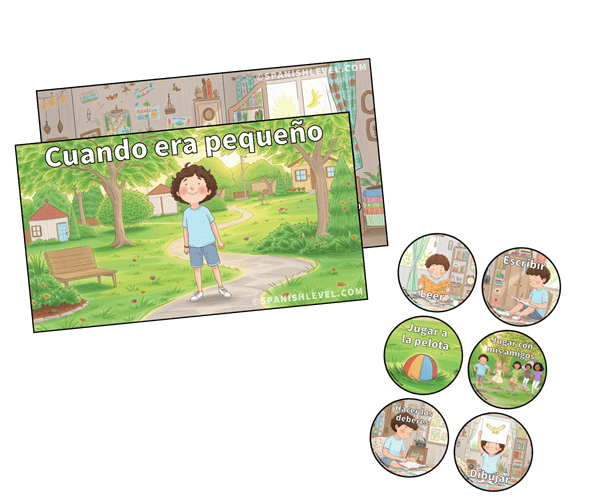
Download the mini illustrated story of "Cuando era pequeño" here.

You can also download flashcards with common verbs here. This is helpful for practicing storytelling and imperfect tense in Spanish.

Spanish -AR Verbs: Fill-in-the-Blanks Exercise

Are you learning Spanish and want to master regular -AR verbs in the present tense? This simple and effective fill-in-the-blanks exercise is just what you need to review the first conjugation and improve your grammar in context.

This Spanish -AR Verbs: Fill-in-the-Blanks exercise allows to review regular -AR verbs in Spanish, which are the most common verb group in Spanish. These verbs are from the first conjugation, like hablar (to speak), estudiar (to study) or bailar (to dance) follow a clear pattern in the present tense. Once you learn how to conjugate them, you’ll unlock hundreds of useful verbs for everyday conversations.

What to do:

Fill in the blanks with the correct form of each verb in parentheses. All the verbs are regular and end in -AR. Use the present tense.

Example: Yo _____ (hablar) español. Yo hablo español.

Click on the play symbol to start the activity.


You may like...

Present Tense in Spanish Practice (I): Fill in the blanks

Fill in the blanks in this text with the correct forms of the verbs in brackets in the present indicative tense in Spanish. With this present tense in Spanish practice, you will be able to practice some common verbs in Spanish in this tense.
(In this case you don't have to worry about accent marks since they are not necessary in these verb forms).

La rutina de Carmen

Escribe la forma correcta del verbo en presente de indicativo.

Carmen 28 años. Carmen alta y morena. Tiene los ojos marrones.

Ella en Madrid, pero nació en Sevilla. De lunes a viernes en una oficina. Ella al trabajo en bicicleta.

La comida favorita de Carmen la paella. Carmen a su abuela a menudo. Ella y su abuela platos deliciosos. Ambas películas antiguas cuando están juntas.

Los fines de semana, Carmen , con sus amigos y a su perro Tom por el parque. Carmen de la vida.

Siguiente / Next