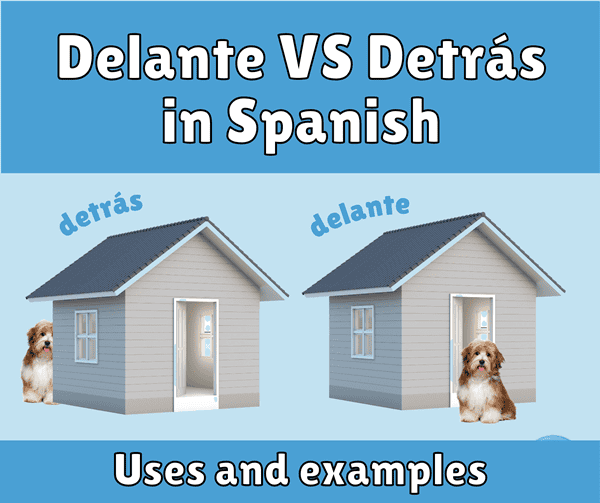
If you’re learning Spanish, one of the first things you’ll need is the ability to describe where things and people are. Whether you’re talking about your house, giving directions or simply describing a picture, location words are everywhere in real communication.
Among these, two of the most common prepositions are “delante de” and “detrás de”. At first glance, they seem easy (just “in front of” and “behind”, right?) but in practice, many students mix them up or forget how to use them correctly in a sentence.
The good news? Once you understand the logic behind them, they become super intuitive.
In this post, you’ll learn how to use delante and detrás step by step, with examples, practical tips and links to our activities to help you remember them naturally.
¡Vamos allá!
What do delante de and detrás de mean?
Both words describe position in space:
Detrás de = behind
Delante de = in front of
When followed by a noun, we usually use the preposition “de”:
delante de la casa → in front of the house
detrás de la puerta → behind the door
Delante de
We use delante de when something is in front of another object or person.
Structure:
- delante + de + noun
Examples:
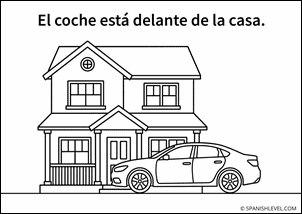
- El coche está delante de la casa.
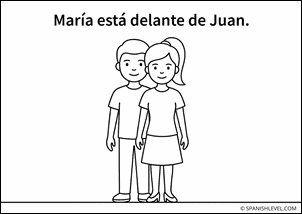
(The car is in front of the house.) - María está delante de Juan.
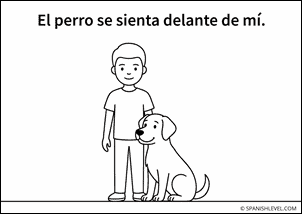
(María is in front of Juan.) - El perro se sienta delante de mí.
(The dog sits in front of me.)
Detrás de
We use detrás de when something is behind another object or person.
Structure:
- detrás + de + noun
Examples:
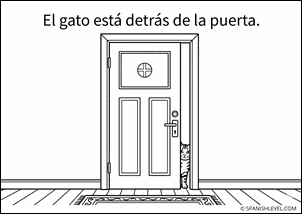
- El gato está detrás de la puerta.
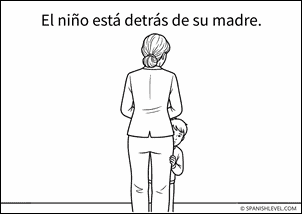
(The cat is behind the door.) - El niño está detrás de su madre.
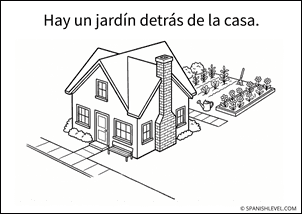
(The child is behind his mother.) - Hay un jardín detrás de la casa.
(There is a garden behind the house.)
Delante de VS Detrás de, the main difference
| SPANISH | ENGLISH | MAIN DIFFERENCE |
|---|---|---|
| delante de | in front of | visible person/animal/object |
| detrás de | behind | hidden person/animal/object |
Example:
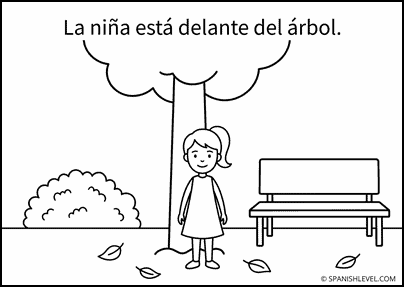
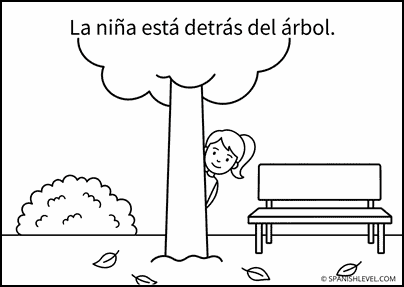
La niña está delante del árbol. (You see her clearly).
La niña está detrás del árbol. (The tree hides her).
Delante de VS Detrás de: common mistakes
1) Missing the preposition “de”
- Incorrect: delante la casa
- Correct: delante de la casa
2) Confusing with “enfrente”
- Enfrente de = opposite (not the same as "delante").
Example:
- El banco está enfrente de la escuela. (across the street)
- El banco está delante de la escuela. (just in front)
Let's sing!
Sometimes, the best way to remember new words in Spanish is not by memorizing… but by listening, repeating and having fun.
This song will help you internalize “delante de” and “detrás de” in a natural and catchy way.
In this video, you’ll hear both prepositions used in context, with clear repetition and rhythm so you can follow along easily.
You can download the song lyrics in this page.