How to describe yourself in Spanish I: la cara (the face)

Learning how to describe yourself in Spanish is one of the most useful skills for real-life communication because we use it constantly. In this post, you’ll learn the most important Spanish vocabulary to describe faces naturally, including hair, eyes, facial features, accessories…

Basic structure to describe yourself in Spanish

A natural order is usually:

Hair → Eyes → Facial features → General appearance (clothes, accessories…)

But today we are going to focus on how to describe a face in Spanish.

Some examples:

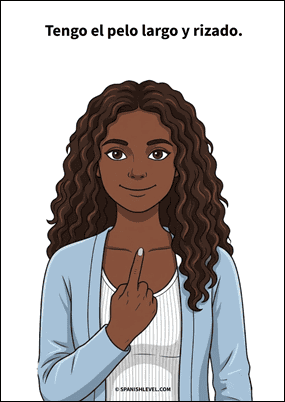
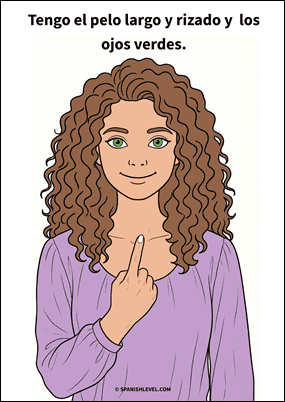
  • Tengo el pelo largo y rizado y (tengo)* los ojos verdes. (I have long, curly hair and green eyes.).
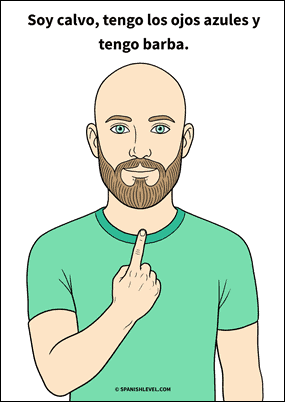
  • Soy calvo, tengo los ojos azules y tengo barba. (I’m bald, I have blue eyes and I have a beard.).

*the second “tengo” can be omitted to avoid repetition, as it is clear from the context.

Use of verb “tener” (to have)

Used for both physical characteristics that can easily change over time (such as hair color or texture) or cannot change (such as eye color).

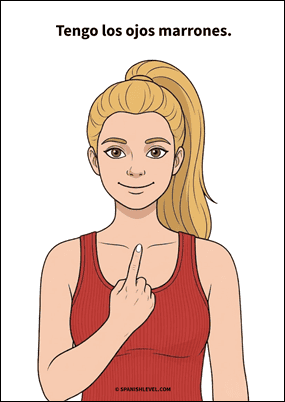
  • Tengo los ojos marrones.
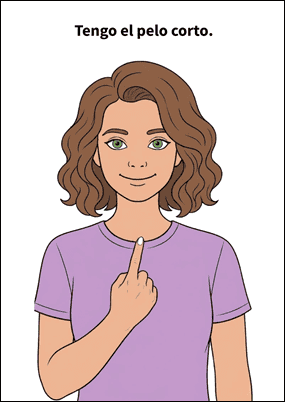
  • Tengo el pelo corto.
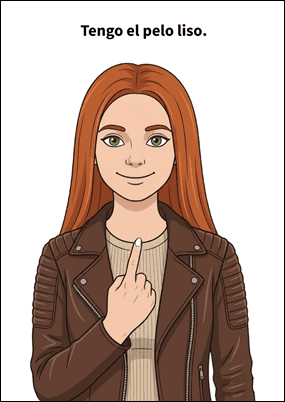
  • Tengo el pelo liso.
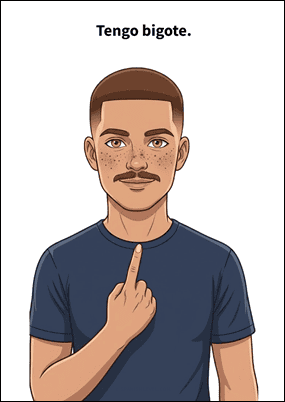
  • Tengo bigote.
  • Tengo el pelo largo y rizado.
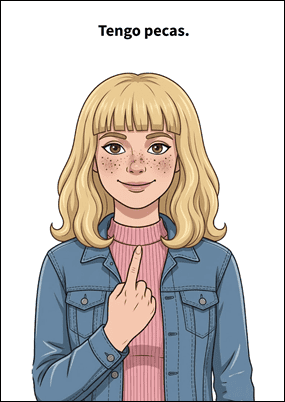
  • Tengo pecas.

Use of verb “ser” (to be)

Used for general physical characteristics which generally do not change or are permanent over a long period of time.

Examples:

  • Soy calvo.
  • Soy guapa.
  • Soy joven.

Use of verb “llevar” (to wear)

This verb is used for accessories, clothes or styles.

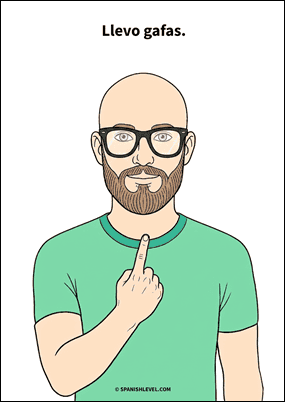
  • Llevo gafas.
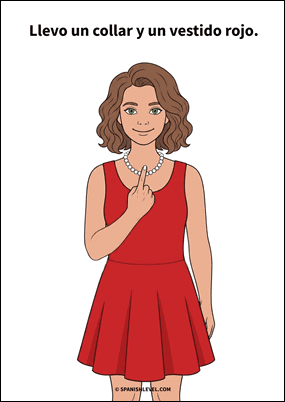
  • Llevo un collar y un vestido rojo.
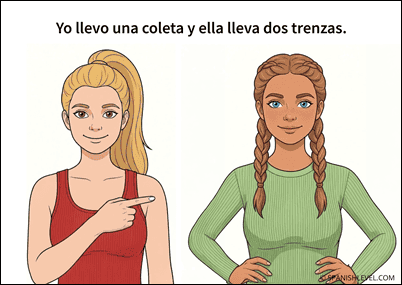
  • Yo llevo una coleta y ella lleva dos trenzas.

Below are some tables with vocabulary related to hair, which is useful for describing facial features in Spanish. We recommend practicing with the exercises provided below.

Hair vocabulary in Spanish

Spanish English
El pelo / el cabello Hair
Pelo largo Long hair
Pelo corto Short hair
Media melena Medium-length hair
Pelo liso Straight hair
Pelo rizado Curly hair
Pelo ondulado Wavy hair
Pelo rubio Blonde hair
Pelo castaño Brown hair
Pelo negro Black hair
Pelo pelirrojo Red hair
Pelo gris Gray hair
Calvo Bald
El flequillo Bangs
La coleta Ponytail
El moño Bun
La trenza Braid
La raya del pelo Hair part
Las mechas Highlights
Los rizos Curls
Las rastas Dreadlocks
La cabeza rapada Shaved head

Face vocabulary in Spanish

Spanish English
Tener barba To have a beard
Tener bigote To have a moustache
Tener perilla To have a goatee
Llevar gafas To wear glasses
Llevar lentillas To wear contact lenses
Tener pecas To have freckles
Tener hoyuelos To have dimples
Tener una cicatriz To have a scar
Tener un lunar To have a mole
Tener los ojos azules To have blue eyes
Tener los ojos verdes To have green eyes
Tener los ojos marrones To have brown eyes
Tener los ojos negros To have black eyes
Tener los ojos grises To have grey eyes
Tener los ojos grandes To have big eyes
Tener los ojos pequeños To have small eyes
Tener las cejas pobladas To have thick eyebrows
Tener las cejas finas To have thin eyebrows
Tener las pestañas largas To have long eyelashes
Tener la nariz grande To have a big nose
Tener la nariz pequeña To have a small nose
Tener la nariz recta To have a straight nose
Tener la nariz respingona To have an upturned nose
Tener los labios finos To have thin lips
Tener los labios carnosos To have full lips
Tener la cara redonda To have a round face
Tener la cara alargada To have a long face
Tener la mandíbula marcada To have a defined jawline
Tener las mejillas sonrosadas To have rosy cheeks
Sonreír mucho To smile a lot

African animals in Spanish

Learning vocabulary related to African animals in Spanish is useful for students because it helps build vocabulary in an engaging and effective way. African animals are commonly featured in stories, documentaries and conversations, making this vocabulary practical and relevant when you are learning Spanish.

Additionally, this topic is an accessible entry topic that also enhances cultural knowledge, as many of these animals are iconic in global contexts, bridging language learning with real-world topics.

So if you want to learn or practice this vocabulary, don’t miss the content of this post, where you will find a vocabulary list, images and related activities.

African animals in Spanish

Los animales de África

Here you can read the names of some African animals, los animales de África or los animales africanos in Spanish.

Español English
León Lion
Elefante Elephant
Jirafa Giraffe
Cebra Zebra
Hiena Hyena
Rinoceronte Rhinoceros
Leopardo Leopard
Cocodrilo Crocodile
Ñu Wildebeest
Hipopótamo Hippopotamus
Avestruz Ostrich
Escorpión Scorpion
Gacela Gazelle

You may like…

Write the names of African animals in Spanish
African Animals in Spanish Memory Game

Jungle Animals in Spanish (Animales de la selva)

Learning vocabulary related to jungle animals in Spanish is a good way to expand your knowledge about animals in this language. From majestic big cats to colorful birds and noisy monkeys, there’s something fascinating about the jungle and its diverse wildlife.

For students of all levels, the theme of jungle animals presents an accessible entry point to Spanish vocabulary and conversation practice. For this reason, here we bring you a vocabulary list with the names of these animals in Spanish.

Los animales de la selva - Jungle animals in Spanish

Los animales de la selva

Here you can read the names of some jungle animal names, los animales de la selva or los animales de la jungla in Spanish.

Español English
Jaguar Jaguar
Mono Monkey
Gorila Gorilla
Tucán Toucan
Serpiente Snake
Caimán Caiman
Guacamayo Macaw
Perezoso Sloth
Hormiga Ant
Chimpancé Chimpanzee
Rana Frog
Tigre Tiger
Pantera Panther
Tapir Tapir
Anaconda Anaconda
Iguana Iguana
Papagayo Parrot

You may like…

Jungle Animals in Spanish Shadow Game
Jungle Animals in Spanish Memory Game
Spanish Word Search Jungle Animals

Telling Time in Spanish

¡Hola amigos y amigas!

This time we are going to learn how to ask what time is in Spanish and also how to tell the time in Spanish. We will look at the different ways of telling the time in Spanish with some examples. And then you can practice with printable exercises and online games.

But… why learn the time in Spanish? Well, telling time in Spanish is very important because it is one of the most common and relevant topics (in any language!), and being able to tell time is a valuable practical skill to have when communicating with Spanish speakers.

Additionally, understanding how to tell time in another language can also provide insight into the culture and ways of life of Spanish-speaking people. And telling time in Spanish can be a fun and interesting way to challenge yourself and improving your language skills. So why not give it a try?

Let’s go, because… ¡el tiempo vuela! (time flies!)

How to ask what time is it in Spanish

One of the first things we need to learn is how to ask what time it is in Spanish. The common way to ask this is:
¿Qué hora es? (What time is it?)

If you add “por favor”, “disculpe” or “perdone” to that question, it will be more polite. This is the most appropriate if you are in a formal situation or you are asking to a stranger or an elderly person. “Por favor” can be added at the beginning or at the end of the question, while “disculpe” or “perdone” are used at the beginning of the question.

There are more polite ways of asking the time that are very common, like the following:
¿Me puede decir la hora, por favor? (Can you tell me the time, please?)
Por favor, ¿me puede decir la hora? (Please, can you tell me the time?)
Disculpe, ¿me puede decir la hora?
(Excuse me, can you tell me the time?)
Perdone, ¿me puede decir la hora?
(Excuse me, can you tell me the time?)

Telling the time in Spanish: an introduction

To tell the time in Spanish we will always use two things: the verb ser and the definite article in feminine. The only thing we have to decide is whether we choose the singular or plural form of both the verb and the article. But this is very simple. Let’s have a look at it.

The first thing we use is the verb. To tell the time in Spanish we always use the verb ser (to be).
We use the present singular form for one hour only:
Es la una. → It’s one o’clock.


And we use the present plural form for the rest of the hours: dos, tres, cuatro, cinco, seis, siete, ocho, nueve, diez, once and doce. For example:
Son las cuatro en punto. → It’s four o’clock.
Son las diez y media. → It’s half past ten.
Son las tres y cuarto. → It’s a quarter past three.

After using the adequate form of the verb ser, you have to use the definite article in feminine in the singular or plural form. The singular form is la, and the plural form, las.

You have to use the singular form with one hour only, one o’clock. → Es la una.
And you will use the plural form with the rest of the hours → Son las doce, son las nueve, etc.

The easiest way to tell the time in Spanish

We are going to see the easiest way to tell the time in Spanish, which is to say the hour number and the minute number. This is the simplest way for a beginner, although it is not the most natural or common way of telling time to other people in most Spanish-speaking countries. It’s fine to use it, specially if you don’t want to complicate things initially, since this form is understandable for everyone in all Spanish-speaking countries despite not being the most common way of telling the time. However, you can often hear this way of telling the time on radio or TV (e.g. on a news programme). The structure of this way of telling the time is the following:

Verb “ser” (es/son) + Definite article (la/las) + hour + y + minutes

See that first of all you have to use the verb “ser” in the singular (es) or plural form (son), then the definite article in feminine singular (la) or plural (las).
See some examples (words in brackets is because they are often omitted):

8:20 → Son las ocho y veinte (minutos) de la mañana.
9:00 → Son las nueve (en punto).
11:15 → Son las once y quince (minutos) de la mañana.
12:00 → Son las doce del mediodía.
13:50 → Es la una y cincuenta (minutos).
16:35 → Son las cuatro y treinta y cinco (minutos).
17:40 → Son las cinco y cuarenta (minutos) de la tarde.
18:00 → Son las seis (en punto).
20:10 → Son las ocho y diez (minutos).
21:12 → Son las nueve y diez (minutos) de la noche.
22:00 → Son las diez de la noche.

As you have seen, the conjunction y serves as a link between the hour and the minutes, except when it is an hour o’clock, when the conjunction is not included.

Note that you can indicate the time of day if you want to be more specific by adding some of these words after telling the minutes:


de la mañana (in the morning)
del mediodía (midday/at noon)
de la tarde (in the afternoon)
de la noche (in the evening)

For example:

8:05 → Son las ocho y cinco (minutos) de la mañana.
12:00 → Son las doce del mediodía.
17:10 → Son las cinco y diez (minutos) de la tarde.
22:00 → Son las diez de la noche.

Common ways to tell the time in Spanish

We are going to see the most common ways to tell the the time in different Spanish-speaking countries.

⏰ From 1 to 30 minutes

From 1 to 30 minutes, all or almost all Spanish-speaking countries use the conjunction y between the hour and the minutes. See the following examples:

8:05 → Son las ocho y cinco.
8:10 → Son ocho y diez.
8:15 → Son las ocho y cuarto (cuarto means 15 minutes). / Son las ocho y quince minutos.
8:20 → Son las ocho y veinte.
8:25 → Son las ocho y veinticinco.
8:30 → Son las ocho y media (media means 30 minutes). / Son las ocho y treinta minutos.

⏰ From 31 to 59 minutes

From 31 to 59 minutes, there are variations depending on the country.

✨ In Spain the most common way to tell the time from 31 to 59 minutes is using the adverb menos between the hour and the minutes. This way of telling the time seems to be common also in Argentina.
Here the adverb menos is followed by the minutes left until the next hour.
For example, 10:45 using the “easiest way to tell the time in Spanish” described above would be said son las diez y cuarenta y cinco minutos, and with this way we would say son las once menos cuarto.
Why this? Because there are fifteen minutes left until eleven (and fifteen minutes are a quarter part of an a hour, and a quarter means un cuarto in Spanish).
So the most common way to tell the time (from 31 to 59 minutes) in Spain is the following:

hour + menos + minutes

Examples:

8:35 → Son las nueve menos veinticinco.
12:40 → Es la una menos veinte.
18:45 → Son las siete menos cuarto.
19:50 → Son las ocho menos diez.
21:55 → Son las diez menos cinco.

✨ Other Spanish-speaking countries like Mexico, Colombia, Chile, Venezuela, etc. have also their own way of telling time. This is very similar to English, since from 31 to 59 minutes people literally say how many minutes are left until the next hour using the verb ser or faltar (mostly in 3rd person plural), then the minutes and the preposition para and finally the definite article with the hour.

Son / Faltan + minutes + para + la / las + hour

Examples:

8:35 → Son veinticinco para las nueve. / Faltan veinticinco para las nueve.
12:40 → Son veinte para las doce. / Faltan veinte para las doce.
18:45 → Son quince para las siete. / Faltan quince para las siete. /
Son un cuarto para las siete. / Falta un cuarto para las siete.
19:50 → Faltan diez para las ocho. / Son diez para las ocho.
21:55 → Faltan cinco para las diez. / Son cinco para las diez.

Conclusion

In conclusion, telling time in Spanish is relatively straightforward. There are different ways of telling the time depending on the country, and we know that this can be overwhelming and confusing for you, but remember that you can always choose to tell the time in the simplest and easiest way. It may not be the most natural way, but it’s completely correct, it’s not strange at all and everyone will understand you, so no problem! In my opinion, this is the best thing you can do, and once you have mastered the easiest, you can try to learn the most common and natural ways of telling the time in Spain and in the different Hispanic countries of America.
Online Flashcards about Jobs in Spanish 💼 (Part One)

These online flashcards about jobs in Spanish are a great way to learn vocabulary related to occupations in this language. The vocabulary related to jobs in Spanish can be challenging, but with these flashcards it is easy to review and remember the most important vocabulary for you.

The following flashcards contain images related to jobs and audio; just click on the button with the speaker icon to hear the job name. This first part includes 18 flashcards about jobs in Spanish. Some of the occupations on these flashcards are only in masculine and others only in feminine, others are in both genders. But if you would like to know how to spell all these professions in both the masculine and feminine forms, read the table below.

List of these jobs in Spanish in both genders

Job in EnglishJob in Spanish (Masculine)Job in Spanish (Feminine)
Policeman / Policewomanel policíala policía
Doctorel doctor / el médicola doctora / la médica
Plumberel fontanerola fontanera
Bakerel panaderola panadera
Tailorel sastrela sastre, la sastra
Astronautel astronautala astronauta
Nurseel enfermerola enfermera
Waiter / Waitressel camarerola camarera
Teacherel maestro / el profesorla maestra / la profesora
Journalistel periodistala periodista
Surgeonel cirujanola cirujana
Veterinary surgeonel veterinariola veterinaria
Postman / Postwomanel carterola cartera
Farmerel agricultorla agricultora
Firefighterel bomberola bombera
Driverel chófer / el conductorla chófer / la conductora

Why use flashcards to learn vocabulary related to jobs in Spanish?

If you’re like most people, you probably don’t have enough time to sit down and study every day endless and boring vocabulary lists about the names of jobs in Spanish. But that doesn’t mean you can’t improve your vocabulary skills step by step with a little help from our interactive flashcards. These flashcards promote efficient learning using the combination of audio and images, and because these flashcards are online, you don’t need to prepare any materials.

Learning the Spanish job names is also important because it can help you in your job search. There are many different jobs out there, and knowing the right name in Spanish for the position you want is key to impressing potential employers who are interested in employees with knowledge of the Spanish language. When searching for a job in Spanish, it helps to be familiar with the different types of jobs and their corresponding Spanish job titles.

American Countries in Spanish

We are going to see a list with the names of all the American countries in Spanish, which also includes the name of these countries in English.

Remember that countries in Spanish are written with uppercase like in English. However, if you want to write American nationalities in Spanish, you have to do with lowercase.

Country in EnglishCountry in Spanish
United StatesEstados Unidos
BrazilBrasil
CanadaCanadá
MexicoMéxico
Groendland*
(Denmark)
Groenlandia
(Dinamarca)
PeruPerú
ParaguayParaguay
ColombiaColombia
ChileChile
Bolivia Bolivia
Venezuela Venezuela
Ecuador Ecuador
Guyane Guyana
Suriname Surinam
Uruguay Uruguay
Guatemala Guatemala
Cuba Cuba
Honduras Honduras
Nicaragua Nicaragua
Dominican RepublicRepública Dominicana
PanamaPanamá
Costa Rica Costa Rica
Bahamas Bahamas
HaitiHaití
BelizeBelice
El Salvador El Salvador
Jamaica Jamaica
Puerto Rico Puerto Rico
Trinidad and Tobago Trinidad y Tobago
Dominica Dominica
Saint LuciaSanta Lucía
Antigua and Barbuda Antigua y Barbuda
Barbados Barbados
Saint Vincent and the GrenadinesSan Vicente y las Granadinas
GrenadaGranada
Saint Kitts and NevisSan Cristóbal y Nieves
French Guiana*
(France)
Guayana Francesa
Falkland Islands*
(UK)
Islas Malvinas
Guadeloupe* (France)Guadalupe
Martinique*
(France)
Martinica
Turks and Caicos Islands* (UK)Islas Turcas y Caicos
Curaçao* (Netherlands)Curazao
United States Virgin Islands* (US)Islas Vírgenes de los Estados Unidos
Bonaire* (Netherlands)Bonaire
Cayman Islands* (UK)Islas Caimán
Saint Pierre and Miquelon* (France)San Pedro y Miquelón
Aruba* (Netherlands) Aruba
British Virgin Islands* (UK)Islas Vírgenes Británicas
Montserrat* (UK)montserratense
Anguilla* (UK)Anguila
Bermuda* (UK)Bermudas
Saint Martin* (France)San Martín
Sint Maarten (Netherlands)San Martín
Saint Barthélemy* (France)San Bartolomé
Sint Eustatius* (Netherlands)San Eustaquio
Saba* (Netherlands)Saba

European Countries in Spanish

In this post we are going to see a list with the names of the European countries in Spanish that also includes the name of these countries in English.

It is important to remember that countries in Spanish are written with uppercase like in English. However, if we want to write nationalities of European countries in Spanish, we have to do with lowercase.

Country in EnglishCountry in Spanish
SpainEspaña
ItalyItalia
FranceFrancia
Portugal Portugal
TurkeyTurquía
RussiaRusia
UkraineUcrania
KazakhstanKazajistán
GermanyAlemania
SwedenSuecia
Finland Finlandia
DenmarkDinamarca
NorwayNoruega
IcelandIslandia
United KingdomReino Unido
EnglandInglaterra
ScotlandEscocia
WalesGales
IrelandIrlanda
PolandPolonia
GreeceGrecia
BulgariaBulgaria
RomaniaRumania
BelarusBielorrusia
MoldovaMoldavia
AustriaAustria
SwitzerlandSuiza
BelgiumBélgica
HungaryHungría
AzerbaijanAzerbaiyán
ArmeniaArmenia
SerbiaSerbia
Albania Albania
Macedonia Macedonia
Czech RepublicRepública Checa
MonacoMónaco
San Marino San Marino
Georgiageorgiano
Croatia Croacia
LithuaniaLituania
LatviaLetonia
Estonia Estonia
Bosnia Bosnia
SlovakiaEslovaquia
NetherlandsPaíses Bajos
Liechtenstein Liechtenstein
Malta Malta
SloveniaEslovenia
Montenegro Montenegro
CyprusChipre
LuxembourgLuxemburgo
AndorraAndorra

Oceanian Nationalities in Spanish

This list of Oceanian nationalities in Spanish includes the Spanish nationality adjectives for the countries of Oceania, in masculine and feminine, and with their singular and plural forms.

It is important to remember two rules about nationalities in Spanish:

  • Nationalities are written with lowercase.
  • Nationalities agree with the gender and number of the noun they describe.
Nationality in EnglishNationality in Spanish
(Masculine singular)
Nationality in Spanish
(Masculine plural)
Nationality in Spanish
(Feminine singular)
Nationality in Spanish
(Feminine plural)
Australianaustraliano australianosaustralianaaustralianas
Papua New Guineanpapúpapúes, papús papú papúes, papús
Micronesianmicronesiomicronesios micronesia micronesias
Fijianfiyianofiyianosfiyianafiyianas
Cook Islandercookianocookianoscookianacookianas
Solomon Islandersalomonense salomonenses salomonense salomonenses
I-Kiribatikiribatianokiribatianoskiribatianakiribatianas
Marshallesemarshalésmarshalesosmarshalesa marshalesas
Nauruannauruano nauruanos nauruana nauruanas
Niueanniueñoniueñosniueñaniueñas
New Zealanderneozelandésneozelandesesneozelandesaneozelandesas
Palauanpalauano palauanos palauana chinas
Samoansamoano samoanos samoana samoanas
Tongantongano tonganos tongana tonganas
Tuvaluantuvaluano tuvaluanos tuvaluana tuvaluanas
Ni-Vanuatuvanuatuense vanuatuenses vanuatuense vanuatuenses

You may like…

Guess the nationality in Spanish Game

Asian Nationalities in Spanish

This list of Asian nationalities in Spanish includes all the Spanish nationality adjectives for Asian countries in masculine and feminine, and with their singular and plural forms.

Do not forget two things about nationalities in Spanish:

  • They are written with lowercase.
  • They agree with the gender and number of the noun they describe.

Some of these countries have more than one correct gentilicio or demonym in Spanish, like several correct plural forms (this usually happens with many nationalities ending with in singular, as they have two correct endings, –íes and –ís).

A few countries on this list are considered Eurasian (those that have * in the green column).

Nationality in EnglishNationality in Spanish
(Masculine singular)
Nationality in Spanish
(Masculine plural)
Nationality in Spanish
(Feminine singular)
Nationality in Spanish
(Feminine plural)
Afghanafganoafganosafganaafganas
Saudisaudísaudíes, saudíssaudísaudíes, saudís
Armenianarmenioarmeniosarmeniaarmenias
Azerbaijaniazerbaiyano azerbaiyanos azerbaiyana azerbaiyanas
Bangladeshibangladesíbangladesíes, bangladesís bangladesí bangladesíes, bangladesís
Bahrainibahreiníbahreiníes, bahreinís bahreiní bahreiníes, bahreinís
Burmesebirmano birmanosbirmanabirmanas
Bruneianbruneanobruneanosbruneanabruneanas
Bhutanesebutanésbutaneses butanesabutanesas
Cambodiancamboyanocamboyanoscamboyana camboyanas
Qataricatarícataríes, cataríscatarí cataríes, catarís
Chinesechinochinos chinachinas
North Koreannorcoreanonorcoreanosnorcoreananorcoreanas
South Koreansurcoreanosurcoreanossurcoreanasurcoreanas
Emiratiemiratíemiratíes emiratí emiratíes
Filipinofilipinofilipinosfilipinafilipinas
Georgian*georgianogeorgianosgeorgianageorgianas
Egyptian*egipcioegipciosegipciaegipcias
Indianindio indiosindiaindias
Indonesianindonesio indonesios indonesiaindonesias
Iraqiiraquíiraquíes, iraquísiraquí iraquíes, iraquís
Iranianiraníiraníes, iranísiraní iraníes, iranís
Palestinianpalestinopalestinospalestinapalestinas
Japanesejaponésjaponesesjaponesajaponesas
Jordanianjordanojordanosjordanajordanas
Kazakhstani*kazajokazajoskazajakazajas
Kyrgyzkirguískirguiseskirguisakirguisas
Kuwaitikuwaitíkuwaitíes, kuwaitískuwaití kuwaitíes, kuwaitís
Laolaosianolaosianoslaosianalaosianas
Lebaneselibanéslibaneseslibanesalibanesas
Maldivianmaldivomaldivosmaldivamaldivas
Malaysianmalasiomalasiosmalasiamalasias
Mongolianmongol mongolesmongolamongolas
Nepalinepalínepalíes, nepalís nepalí nepalíes, nepalís
Omaniomaníomaníes, omanís omaní omaníes, omanís
Pakistanipakistaní pakistaníes, pakistaníspakistaní pakistaníes, pakistanís
Russian*rusorusosrusarusas
Singaporeansingapurense singapurenses singapurense singapurenses
Syriansiriosiriossiriasirias
Sri Lankanesrilanquésesrilanquesesesrilanquesaesrilanquesas
Thaitailandéstailandesestailandesatailandesas
Tajikistanitayiko tayikostayikatayikas
Timoresetimorensetimorenses timorensetimorenses
Turkmenistaniturkmenoturkmenosturkmenaturkmenas
Turkish*turcoturcosturcaturcas
Uzbekistaniuzbekouzbekosuzbekauzbekas
Vietnamesevietnamitavietnamitasvietnamitavietnamitas
Yemeniyemeníyemeníes, yemenísyemení yemeníes, yemenís

You may like…

Guess the nationality in Spanish Game

African Nationalities in Spanish

In this post we are going to learn the African nationalities in Spanish with a list that includes Spanish nationality names for African countries in masculine and feminine, and with their singular and plural forms.

It is important to remember two things about nationalities in Spanish:

  • Nationalities in Spanish are written with lowercase.
  • Nationality adjectives agree with the gender and number of the noun they describe.

Some of these countries have more than one correct gentilicio or demonym in Spanish (and in some cases several correct plural forms).

Nationality in EnglishNationality in Spanish
(Masculine singular)
Nationality in Spanish
(Masculine plural)
Nationality in Spanish
(Feminine singular)
Nationality in Spanish
(Feminine plural)
Angolanangoleñoangoleñosangoleñaangoleñas
Algerianargelinoargelinosargelinaargelinas
Beninesebeninésbeninesesbeninesabeninesas
Motswana (sg) Batswana (pl)botsuano botsuanos botsuana botsuanas
Burkinabéburkinésburkinesesburkinesa groenlandesas
Burundianburundésburundesesburundesaburundesas
Cape Verdeancaboverdiano caboverdianos caboverdiana caboverdianas
Camerooniancamerunéscamerunesescamerunesacamerunesas
Chadianchadianochadianoschadianachadianas
Comoriancomorense comorensescomorensecomorenses
Ivorianmarfileño marfileños marfileña marfileñas
Egyptianegipcio egipcios egipcia egipcias
Eritreaneritreoeritreoseritreaeritreas
Ethiopianetíope etíopes etíope etíopes
Gabonesegabonésgabonesesgabonesagabonesas
Gambiangambianogambianosgambianagambianas
Ghanaianghanésghanesesghanesaghanesas
Guineanguineanoguineanosguineanaguineanas
Bissau-Guineanbisauguineano bisauguineanos bisauguineana bisauguineanas
Equatoguineanecuatoguineano ecuatoguineanos ecuatoguineana ecuatoguineanas
Kenyankenianokenianoskenianakenianas
Mosotho (sg)
Basotho (pl)
lesotenselesotenseslesotense lesotenses
Liberianliberianoliberianosliberianaliberianas
Libyanlibiolibioslibialibias
Malagasymalgachemalgachesmalgache malgaches
Malawianmalauímalauíesmalauímalauíes
Malianmaliensemaliensesmaliense malienses
Moroccanmarroquímarroquíes, marroquísmarroquí marroquíes, marroquís
Mauritianmauricianomauricianosmauricianamauricianas
Mauritanianmauritanomauritanosmauritanamauritanas
Mozambicanmozambiqueño mozambiqueños mozambiqueña mozambiqueñas
Namibiannamibionamibiosnamibianamibias
Nigeriennigerino nigerinosnigerinanigerinas
Nigeriannigerianonigerianos nigeriananigerianas
Central Africancentroafricano centroafricanos centroafricana centroafricanas
Congolesecongoleño congoleños congoleña congoleñas
Rwandan, Rwandeseruandésruandesesruandesa ruandesas
Saharawisaharauisaharauissaharauisaharauis
Santomeansantotomense santotomensessantotomensesantotomenses
Senegalesesenegaléssenegalesessenegalesasenegalesas
Seychelloisseychelenseseychelensesseychelenseseychelenses
Sierra Leoneansierraleonés sierraleonesessierraleonesasierraleonesas
Somali,
Somalian
somalísomalíes, somalíssomalísomalíes, somalís
Somalilandersomalilandéssomalilandesessomalilandesasomalilandesas
Liswati (sg)
Emaswati (pl)
suazisuazissuazisuazis
South Africansudafricanosudafricanossudafricanasudafricanas
Sudanesesudanéssudanesessudanesasudanesas
South Sudanesesursudanéssursudanesessursudanesasursudanesas
Tanzaniantanzano tanzanos tanzanatanzanas
Togolesetogoléstogoleses togolesatogolesas
Tunisiantunecino tunecinostunecinatunecinas
Ugandanugandés ugandeses ugandesa ugandesas
Djiboutianyibutianoyibutianos yibutiana yibutianas
Zambianzambianozambianos zambiana zambianas
Zimbabweanzimbabuense zimbabuenses zimbabuense zimbabuenses

You may like…

Guess the nationality in Spanish Game