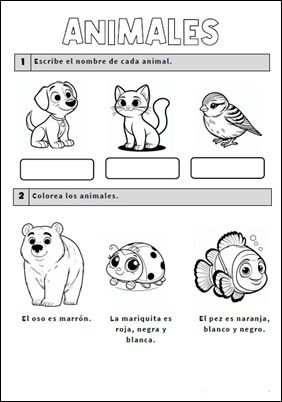
Looking for a fun, online and interactive way to learn Spanish vocabulary? This Spanish Word Search: Jungle Animals is all you need! This is an engaging activity that help beginners practice key words while having fun.
This activity includes a selection of jungle animals commonly used in beginner-level Spanish. Learners will practice words like serpiente, gorila or chimpancé. This is perfect for A1-A2 students, whether you’re an independent learner or a teacher teaching kids, teens or adults.
This activity requires no preparation—just open and play! It’s engaging, and by searching for the hidden words, students reinforce their vocabulary through repetition and visual recognition. Plus, it’s fully compatible with tablets, laptops and smartphones, so you can use it in various settings. Whether you’re teaching in a classroom or learning independently, this word search is a fun and flexible way to boost Spanish skills.
Click on the play symbol to start the activity.
How to use it in class
You can use this Spanish word search in different ways:
As a warm-up or closing activity.
To review animal vocabulary after a jungle-themed lesson.
As a team challenge: who can find all the animals the fastest?
As a digital center or homework assignment.
If you’re working with younger learners, pair the activity with jungle songs or animal flashcards for a more immersive experience.
If you’re just beginning your journey to learn Spanish, there’s no better way to start than with a short story crafted specifically for beginners. Un lugar secreto – Spanish story for beginners invites readers into a world of curiosity and nature through the eyes of a young adventurer named Andrea. This beginner-friendly Spanish story is designed to help you improve your Spanish comprehension, vocabulary and overall confidence.
In this narrative, Andrea stumbles upon a mysterious path that leads her to a hidden place. But what is this hidden and magical spot really about? And why does it feel so special to her? You’ll have to read (or watch!) the full story to find out.
What you’ll get
To make the most of your reading experience, we’ve included everything you need to immerse yourself in this Spanish resource for beginners:
A captivating video narrating the full story in Spanish (with and without subtitles) and with English subtitles.
PDF with the full story in Spanish.
English translation for easy comparison.
A comprehension test with answer key to test your understanding.
Below you can find the video and the download links.
Spanish Short Story for beginners: Un lugar secreto
Ella vive en un pequeño pueblo rodeado de bosques y colinas. Cada fin de semana, coge su mochila y se va de aventuras.
Una tarde, mientras caminaba cerca de un viejo roble, vio algo extraño. Detrás de la hierba había un camino que nunca antes había visto.
“¿A dónde llevará?”, se preguntó.
Curiosa, Andrea siguió el camino. Los árboles a su alrededor se volvían más altos, y el aire se sentía más fresco. De repente, vio una pequeña puerta de madera oculta en la ladera de una colina.
Dudó por un momento y luego empujó la puerta con suavidad. Al abrir la puerta descubrió un precioso jardín secreto. Por todas partes había flores de colores, y una pequeña cascada en un estanque de aguas cristalinas. Las mariposas volaban y los pájaros cantaban.
Andrea estaba asombrada. Parecía un lugar mágico, intacto por el paso del tiempo.
Se acercó al estanque y vio un viejo banco de madera bajo un gran cerezo. Alguien había grabado unas palabras en el banco:
“Un lugar para ser libre”.
Andrea sonrió. “Este es mi lugar secreto ahora”, pensó.
Desde aquel día, Andrea visita el jardín siempre que quiere estar sola, leer un libro o simplemente escuchar la naturaleza.
Es su refugio especial, un mundo escondido solo para ella.
How to make the most of this story
Retell the story in your own words, either by speaking or writing, to deepen your learning and boost your confidence.
Start by reading the story in Spanish, highlighting or jotting down any words you don’t recognize.
Use the English translation to confirm meanings—but avoid leaning on it too heavily.
Read the Spanish version again, this time out loud, to build your pronunciation and fluency.
Take the comprehension quiz to see how well you understood the story and to reinforce key points.
So, you’ve decided to learn Spanish? ¡Genial! Let’s start with one of the most important foundations: the present simple tense, or as we call it in Spanish, el presente de indicativo.
This is the tense you’ll use every day—to talk about routines, facts, likes and dislikes… basically, it’s your daily bread when speaking Spanish.
Don’t worry if you’re totally new. I’ll guide you step by step. Ready? ¡Vamos!
What is the Spanish present tense?
The present simple tense in Spanish is used to talk about:
Habits or routines → Yo estudio español todos los días. (I study Spanish every day.)
Facts and general truths → El sol sale por el este. (The sun rises in the east.)
Emotions and opinions → Me gusta el chocolate. (I like chocolate.)
What’s happening right now (sometimes) → Estoy cansado. (I’m tired.)
💡 Unlike English, Spanish verbs change their endings depending on the subject. That’s called conjugation.
How Spanish verbs work: the basics
In Spanish, infinitive verbs (like “to speak”, “to eat”, “to live”) end in -ar, -er or -ir.
Here are three regular verbs we’ll use as examples:
Infinitive
Meaning
Verb type (conjugación)
hablar
to speak
-ar
comer
to eat
-er
vivir
to live
-ir
Subject pronouns in Spanish
Let’s meet the “doers” of the action (subject pronouns). These are optional in Spanish, but useful for beginners:
Spanish
English
yo
I
tú
you (informal)
él – ella – usted
he – she – you (formal)
nosotros/as
we
vosotros/as
you all (informal – Spain only)
ellos/as – ustedes
they – you all (formal)
Regular verb conjugation in the Present Tense
Let’s see how regular verbs in Spanish work. When you conjugate a verb, you change its ending to match the subject (the person doing the action). In English, we do this too — think about the verb to speak:
She speaks
I speak
In Spanish, this happens more often and more visibly, because almost every subject has its own verb ending.
The basic rule:
All regular verbs in Spanish follow a patternbased on their endings:
–AR (e.g. hablar – to speak)
–ER (e.g. comer – to eat)
–IR (e.g. vivir – to live)
Here’s the process in 3 simple steps:
Take the infinitive (like hablar)
Remove the ending (-ar, –er, –ir) → you get the “stem” (habl-)
Add the correct endingdepending on the subject.
For example:
yo → hablo
tú → hablas
nosotros → hablamos
Each regular verb group (-AR, –ER, –IR) has its own set of endings, and once you learn them, you can conjugate hundreds of verbs!
Tip: Spanish often drops the subject pronounbecause the verb ending already tells you who is doing the action. So instead of saying yo hablo, many speakers just say hablo.
Verbs ending in -AR (First conjugation)
Pronoun
Conjugation
Example
yo
hablo
I speak
tú
hablas
you speak
él / ella / usted
habla
he/she/you (formal) speak
nosotros/as
hablamos
we speak
vosotros/as
habláis
you all speak (Spain)
ellos / ellas / ustedes
hablan
they/you all speak
Verbs ending in -ER (Second conjugation)
Pronoun
Conjugation
Example
yo
como
I eat
tú
comes
you eat
él / ella / usted
come
he/she/you (formal) eat
nosotros/as
comemos
we eat
vosotros/as
coméis
you all eat (Spain)
ellos / ellas / ustedes
comen
they/you all eat
Verbs ending in -IR (Third conjugation)
Pronoun
Conjugation
Example
yo
vivo
I live
tú
vives
you live
él / ella / usted
vive
he/she/you (formal) live
nosotros/as
vivimos
we live
vosotros/as
vivís
you all live (Spain)
ellos / ellas / ustedes
viven
they/you all live
As you see, only the endings change. The root stays the same (habl-, com-, viv-).
Quick tips to master the present tense in Spanish
Mastering the present tense takes practice, but don’t worry — it’s easier than it seems once you spot the patterns. Here are some quick, practical tips to help you use regular Spanish verbs with confidence from day one:
Focus on one verb type (-ar, -er, -ir) at a time.
Practice with common verbs: hablar, comer, vivir, trabajar, estudiar, leer, escribir…
Learning Spanish doesn’t have to mean memorizing endless lists of verbs or repeating phrases without context. One of the most effective and fun ways to build vocabulary and fluency is by reading short stories that connect with everyday experiences and emotions.
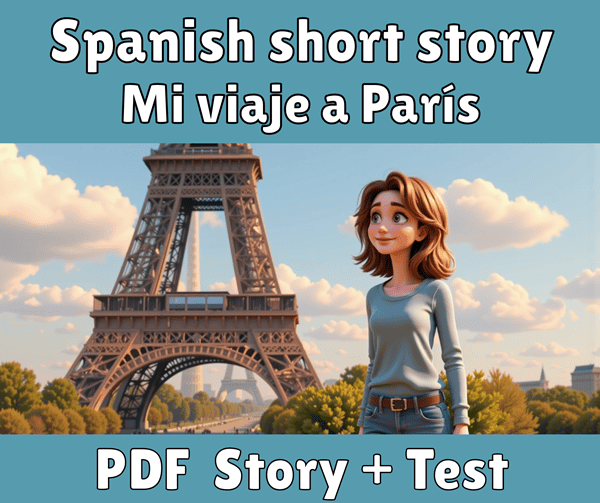
That’s why we’re excited to share our Spanish story for beginners – Mi viaje a Paris. This short narrative follows a young woman on her first journey to the French capital—and it’s told entirely in simple, clear Spanish, perfect for early learners.
What’s included?
In this post you will find:
The video with the story.
PDF with the story in Spanish and translation into English.
PDF with a test about the story. Test your comprehension with ten questions. Answer key included.
Below you can find the video and the download links.
Spanish Short Story for beginners: Mi viaje a París
¡Hola! Me llamo Olivia y el verano pasado fui a París. Era mi primera vez en Francia, y estaba muy emocionada.
El primer día visité la Torre Eiffel. ¡Era tan alta y bonita! Hice muchas fotos y comí un delicioso cruasán en una pequeña cafetería cercana.
Al día siguiente fui al Museo del Louvre. ¡Vi la Mona Lisa! Había muchos cuadros y estatuas preciosas. El museo era muy grande y caminé mucho.
También visité la Catedral de Notre-Dame. La catedral era antigua e impresionante. Subí muchas escaleras para ver la ciudad desde lo alto. ¡Las vistas eran fantásticas!
Una tarde caminé por los Campos Elíseos. Había muchas tiendas y restaurantes. Compré un pequeño recuerdo para mi familia. Luego me senté en un parque y comí un crêpe con chocolate. ¡Estaba delicioso!
En mi último día paseé en barco por el río Sena. El agua estaba tranquila y la ciudad se veía mágica de noche. Las luces de París eran preciosas.
Me encantó mi viaje a París. La ciudad me pareció maravillosa y la comida fue increíble.
¡Espero volver algún día!
How to make the most of it
Read the story first in Spanish and underline or note any unfamiliar words.
Check the English version to clarify meaning—but don’t rely on it too much!
Re-read the Spanish aloud to improve pronunciation and fluency.
Complete the quiz to test how much you understood and reflect on key details.
Try retelling the story in your own words as a speaking or writing exercise.
Learning a language is about more than just memorizing grammar rules and vocabulary lists—it’s also about connecting with everyday life, relatable situations and real emotions. That’s exactly what you’ll find in the Spanish story for beginners: Visita al dentista, a short and simple that will help you improve your skills.
This story follows a young woman named Sofía who wakes up one morning with a troubling toothache. From the moment she realizes something isn’t quite right to her visit to the dental clinic, readers are taken through a relatable and realistic experience—all told in clear, accessible Spanish.
Sofía’s day includes everything from discomfort and worry to relief and rest. It’s a complete mini-journey in less than two pages, full of natural dialogue and everyday vocabulary that learners can use in real-life situations.
What’s included?
In this post you will find:
The video with the story in Spanish and English.
PDF with the story, in Spanish and translation into English.
PDF with a test about the story. Test your comprehension with ten questions. Answer key included.
Below you can find the video and the download links.
Spanish Short Story for beginners: Visita al dentista
Esta es Sofía. Tiene 26 años. Hoy se despierta con dolor en un diente. Se toca la mejilla y siente que está un poco hinchada. Ella va al baño, se mira la boca en el espejo, pero no ve nada. Después del desayuno, el dolor es más fuerte. “Algo no va bien”, piensa Sofía preocupada. Ella decide lavar sus dientes y usar el hilo dental con cuidado, pero el dolor continúa. Así que Sofía decide llamar al dentista para pedir una cita urgente. “Hola, tengo un fuerte dolor en algún diente. ¿Puedo ir hoy?” pregunta Sofía. La recepcionista responde: “Sí, tenemos una cita disponible a las tres de la tarde.” “Perfecto, estaré allí. Gracias”, dice Sofía. Hasta la hora de la cita, ella decide tomar unos analgésicos para intentar descansar un poco. A las dos y media, Sofía sale de casa y camina hacia la clínica dental. Ella llega a la clínica y se sienta en la sala de espera. Después de unos minutos, la llaman para entrar en la consulta. “Hola, Sofía. ¿Qué te pasa?” pregunta el dentista. “Me duele mucho un diente desde esta mañana”, dice Sofía. “Parece que tienes una caries. Necesito hacer un pequeño tratamiento”, explica el dentista mientras revisa su boca. “¿Va a doler?” pregunta Sofía con un poco de miedo. “No te preocupes, usaré anestesia. No sentirás nada”, dice el dentista. Sofía respira hondo y cierra los ojos mientras el dentista trabaja. Después de unos minutos, el dentista termina el tratamiento. “Todo listo, Sofía. Ahora todo está bien”, dice el dentista. “¡Muchas gracias, doctor! ¡Me siento mucho mejor!” dice Sofía, aliviada. El dentista le recomienda no comer nada duro por unas horas. Sofía paga en recepción y sale de la clínica con una gran sonrisa. Camina de regreso a casa sintiéndose más relajada. Cuando llega a casa, se prepara una sopa caliente para cenar. “Hoy fue un día difícil, pero ahora estoy bien”, piensa Sofía. Finalmente, se acuesta en la cama y se duerme con alivio.
Why is “Visita al dentista” a great resource for Spanish learners?
If you are asking why you should use this story for you or your students, keep reading these reasons:
1. Everyday context This story focuses on a situation most of us have experienced: a sudden health issue and a trip to the doctor—in this case, the dentist. This makes it perfect for learning practical vocabulary related to health, the body, feelings, appointments and common actions.
2. Clear language and simple grammar Written specifically for beginners, the story uses straightforward grammar in the present tense and clear sentence structures. It avoids complex idioms or advanced expressions, making it easy to follow even with limited knowledge of Spanish.
3. Realistic dialogue Conversations between Sofía and the receptionist, as well as between her and the dentist, help learners become familiar with polite forms, basic questions and how Spanish is used in a professional context.
How to use this story in your Spanish learning routine:
Read the Spanish version first to see what you understand on your own.
Use the English translation to confirm or discover meanings of unknown words.
Re-read the story out loud to improve pronunciation and fluency.
Take the test to review key details and reinforce your comprehension.
Discuss it with a partner or tutor to practice speaking and sharing ideas (if possible).
Learning a new language can be a magical journey—and sometimes, all it takes is a single story to spark curiosity, imagination and motivation. “La moneda mágica” is a short, heartwarming story written in simple Spanish, perfect for beginner learners who want to build vocabulary, improve reading and listening comprehension and engage emotionally with the language.
The Spanish story for beginners: La moneda mágica is designed for beginners (A1-A2 level) and intermediate students, and it will help you enhance your vocabulary, grammar and listening skills.
This story follows Lucas, a curious and optimistic boy who discovers a shiny golden coin on the street. At first, it seems like just an ordinary coin—but soon, Lucas realizes that every time he tosses it into the air, something happens.
This story is more than just a tale of a boy and a magical coin. It’s a meaningful, easy-to-follow narrative designed with beginner Spanish learners in mind. The language is clear, the sentence structures are simple, and the plot is engaging enough to encourage learners to keep reading. It’s ideal for young students, self-learners or classroom use.
What’s included?
In this post you will find:
The video with the story, only in Spanish.
PDF with the story, in Spanish and translation into English.
PDF with a test about the story. Test your comprehension with ten questions. Answer key included.
Below you can find the video and the download links.
Spanish Short Story for beginners: Un día en la vida de Antonio
Lucas es un niño curioso. Un día, él camina por la calle y ve algo en el suelo. Es una moneda dorada y brillante, y tiene el símbolo de un corazón en el centro. Lucas coge la moneda y la guarda en su bolsillo. En su dormitorio, él mira la moneda. Es una moneda muy brillante. Lucas la lanza al aire. Cuando la moneda cae al suelo, suena el teléfono. Su madre responde al teléfono. Es la tía de Lucas. “Dile a Lucas que mañana le llevaré un regalo.” Dice la tía de Lucas. Lucas está feliz y salta de alegría. “¡Un regalo, un regalo! ¿Qué será?” Piensa. Al día siguiente, en la escuela, Lucas lanza la moneda otra vez. A los cinco minutos, una compañera le da una chocolatina. Lucas se da cuenta de que, cada vez que lanza la moneda, algo bueno pasa. Un día lanza la moneda y encuentra golosinas en su mochila. Más tarde lanza la moneda y saca la mejor nota de la clase. Otro día lanza la moneda y su madre prepara pizza, su comida favorita. Cada vez que Lucas lanza la moneda ocurre algo bueno. Entonces, Lucas piensa… “¡esta moneda es mágica!”. Pero un día, al lanzar la moneda, no pasa nada. Lo intenta una y otra vez. Pero sigue sin pasar nada. Lucas se siente extraño. Prueba una última vez. La moneda brilla y, de repente, desaparece en el aire. “¿Qué ha pasado?” Se pregunta Lucas, muy confuso. Busca la moneda por todas partes, pero no la encuentra. Al principio, se siente triste, pero luego piensa en alto: “Bueno, Lucas, quizá la suerte no dura para siempre… pero los buenos momentos sí”. Desde ese día, Lucas sigue siendo un niño optimista. Ahora, cuando quiere que algo bueno pase, no lanza una moneda, sino que ayuda a los demás. Descubre que la verdadera magia está en sus acciones y en su corazón.
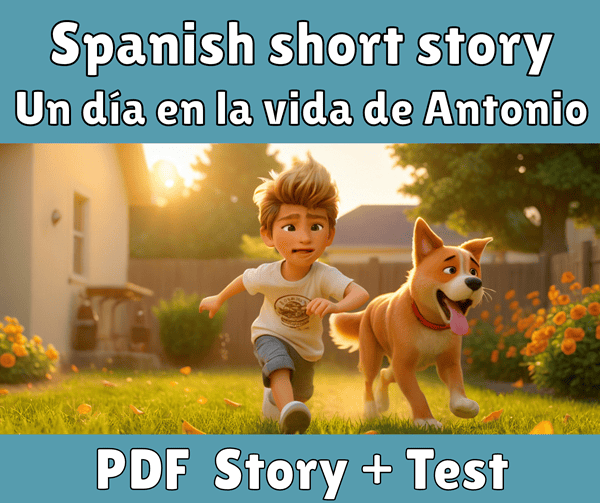
A great way to practice Spanish is by reading and listening to simple and short stories. Today, we’re sharing a short story about Antonio, an eight-year-old boy, and his daily routine. From waking up early in the morning to going to school, playing with his friends, doing homework and spending time with his family, Antonio’s day is full of activities. Through his story, you’ll learn useful vocabulary and expressions related to everyday life, helping you improve your Spanish in an effective and engaging way.
The Spanish story for beginners: Un día en la vida de Antonio is designed for beginners (A1-A2 level) and it will help you enhance your vocabulary, grammar and listening skills.
You’ll learn and practice useful vocabulary related to:
Daily routines: with verbs in present simple like despertarse (waking up) or hacer los deberes / hacer la tarea (doing homework).
School subjects and activities (favourite subjects, playing with friends and what happens during school hours).
Family and home life (interacting with family members, playing with pets and evening routines).
Time expressions (specific hours for different activities throughout the day).
Common phrases and expressions (things teachers say, daily habits and actions).
Each sentence is short, clear and written in simple Spanish, making it easy for beginners to understand. By the end of this story, you’ll be able to:
Describe a daily routine using time expressions and sequential actions.
Identify and use common vocabulary related to school, meals, playtime and family activities.
Understand simple sentences that narrate everyday events in a logical order.
Answer questions about a person’s daily habits and schedule.
Talk about your own routine by comparing it with Antonio’s day.
What’s included?
In this post you will find:
The video with the story, only in Spanish.
PDF with the story, in Spanish and translation into English.
PDF with a test about the story. Test your comprehension with questions about Antonio’s day.
Below you can find the video and the download links.
Spanish Short Story for beginners: Un día en la vida de Antonio
Antonio es un niño de ocho años. Vamos a ver cómo es un día de su vida. Cada mañana, Antonio se levanta a las siete en punto. Después de levantarse, toma el desayuno. Normalmente, cereales con leche o zumo. Cuando acaba de desayunar, se cepilla los dientes. Después se ducha.
Luego se dirige hacia el colegio, que comienza a las nueve en punto. Las asignaturas favoritas de Antonio son las matemáticas y el arte. Su maestra siempre le dice: “¡Eres muy creativo, Antonio!” En el descanso le gusta jugar al fútbol con sus compañeros. A la una y media, Antonio come en el comedor del colegio. Después del colegio, Antonio vuelve a casa y hace los deberes. Después de acabar los deberes, Antonio juega con su hermana pequeña. También suele jugar en el jardín con su perro, y a veces va al parque a jugar con otros niños. Antonio cena junto a su familia a las ocho en punto. Antes de dormir, Antonio suele leer un libro. Le encantan las historias de aventuras. A las nueve de la noche, Antonio se va a dormir y a descansar. ¡Mañana comenzará un nuevo día!
Practice Spanish spelling with the Spanish Spelling Bee Game – Basic Level 4!
This activity is for elementary or basic level learning, and is the fourth part of a Spanish Spelling Bee series for beginners, both kids and adults.
Important: keep in mind that in one of the six words you will need to write an accent mark (use the special character buttons for this).
I hope you find it useful and entertaining!
Instructions of this Spanish Spelling Bee
Click “Start” to begin. On the screen you will see four buttons: Word, Spell, Sentence and Definition. If you click on “Word”, you will listen the word you must write correctly in the blank, and if you click the “Spell” button, you will hear the word spelled out.
If you need more clues, you can click on the “Sentence” and “Definition” buttons. With the first one you will hear a sentence that includes the word. And if you click on the “Definition” button, you will see a definition of that word.
If you write the correct word, the little bee will be happy and you will be able to move on the next screen, until you finish the whole game. If you provide an incorrect answer, don’t worry, you can try again as many times you need! 🙂
Use the special character buttons whenever you need. However, the basic level Spanish spelling bees usually do not require the use of upper case or other special characters, unless otherwise stated. In fact, this Spanish Spellig be is case insensitive, so you don’t need to worry about this.
A great way to practice Spanish is by reading and listening to simple, relatable stories. Today, we’re sharing a short story about Antonio and María, two friends who go to the park and stumble upon a mysterious tree with a small locked door that they want to open. Their adventure leads them to unexpected discoveries, but what’s behind the door remains a mystery until they finally unlock it…
The Spanish story for beginners: Aventura en el parque is designed for beginners (A1-A2 level) and it will help you enhance your vocabulary, grammar and listening skills.
You’ll learn and practice useful vocabulary related to:
Nature and the outdoors: With words like “árbol”, “lago” and other park elements.
Exploration and Discovery: terms for searching, finding, maps and hidden objects.
Emotions and reactions: expressions of excitement, surprise and curiosity.
Basic dialogue and verbs: common phrases, past tense verbs and everyday interactions.
Each sentence is short, clear and written in simple Spanish, making it easy for beginners to understand.
What’s included?
In this post you will find:
The video with the story, only in Spanish.
PDF with the story, in Spanish and translation into English.
PDF with a test about the story. Test your comprehension with questions about the adventure story of these two friends.
Below you can find the video and the download links.
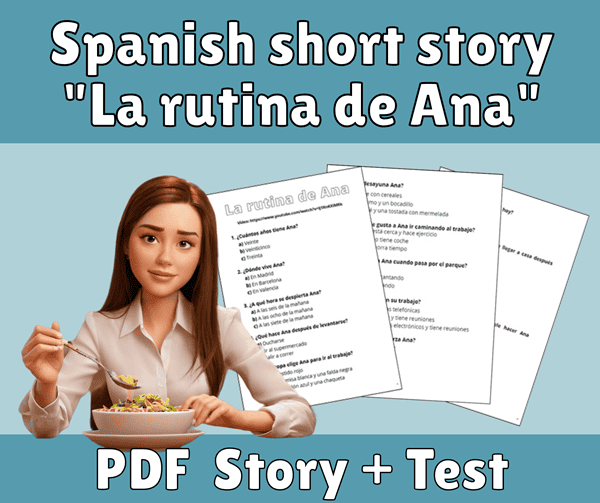
Spanish Short Story for beginners: Ana’s routine
Aventura en el parque (Adventure in the park), story and test
Antonio y María son amigos. Un día, los dos fueron al parque. “¡Vamos a explorar!” Dijo María. Allí vieron un árbol muy grande. En el árbol había una pequeña puerta cerrada. De repente escucharon una voz. ¡Era una ardilla hablando! “Buscad la llave de la puerta en el parque.” Dijo la ardilla. “¡Vamos a buscar la llave!” Dijeron ambos emocionados. María buscó entre las flores. Pero sólo encontró una moneda. Fueron al lago del parque. Allí Antonio encontró un mapa debajo de unas piedras. El mapa mostraba una roca cerca de los columpios. Allí estaba la llave. “¡Tenemos que ir a los columpios!” Le dijo Antonio a María. Ambos corrieron hacia los columpios. Movieron una roca. ¡Allí estaba la llave! Los amigos volvieron al árbol para abrir la puerta con la llave. Al entrar, los dos se sorprendieron. “¡Esto es increíble!” Dijo María. Los dos se divirtieron con los juguetes y libros que había allí. Después de un rato, los dos volvieron a casa. “¡Lo hemos pasado muy bien!” Dijo Antonio. “Sí, ¡mucho!” Le respondió María. María y Antonio volvieron felices a sus casas pensando en su próxima aventura.
Are you looking for a fun and effective way to practice Spanish basic vocabulary? We’ve got the perfect activity for you! The Spanish vocabulary activity: choose the correct image 1 is an interactive image quiz designed to help students, especially beginners, expand their vocabulary in a playful and effective way.
In this interactive activity, you will be asked a series of questions in Spanish. Each question will be followed by three images. Your task is simple: select the image that best matches the word or concept being asked. For example:
Question: “Está lloviendo. ¿Cuál de estos objetos utilizas?”
A) Paraguas (Umbrella)
B) Batidora (Blender)
C) Collar (Necklace)
You would choose the option A, paraguas (umbrella), because that’s what you’d use when it’s raining!
Enjoy the challenge and have fun while practicing Spanish!
If you see a play button or a grey screen, click on it to see the game.